

Manufacturing AI Precision Is Determined by Shopfloor Data
Problem
80% of AI projects fail, and 70% of those failures are caused by data quality issues. Manufacturing shopfloors have dozens of data touchpoints from receiving to shipping, but most data is fragmented, manually entered, or not collected at all — falling far short of what AI needs to learn from.
Solution
AX success is determined not by AI algorithms, but by shopfloor data quality. The diverse data generated across manufacturing — 1D/2D barcodes, engraved DPM codes, and text (OCR) — must be captured accurately and in real time for AI analytics to achieve meaningful precision.
Outcome
- Error rates drastically reduced from manual entry (30-40 errors per 1,000 entries) to automated scanning
- Receiving, inventory, and shipping workflows up to 10x faster
- Clean, real-time data foundation established for AI model training
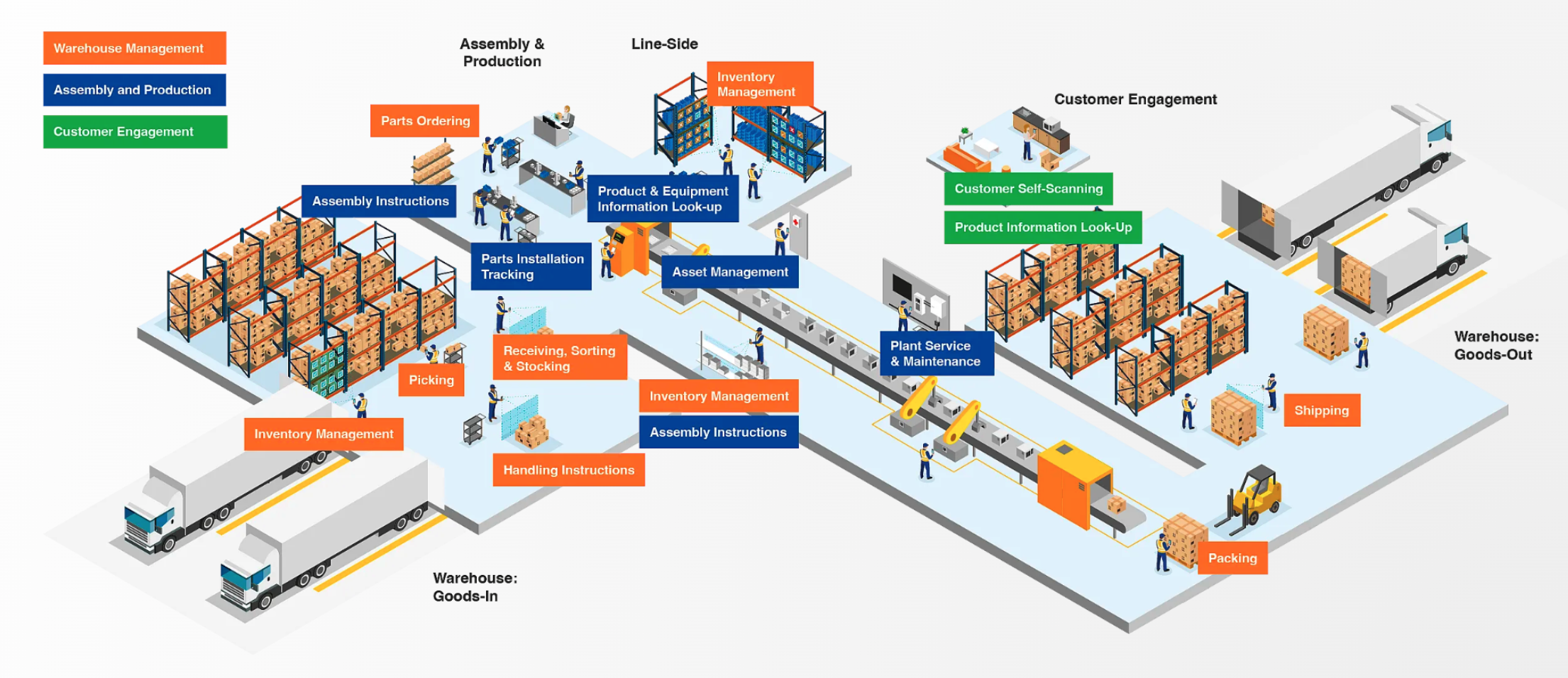
On any manufacturing shopfloor, dozens of data touchpoints exist from the moment raw materials arrive to the moment finished goods ship out. Receiving inspection, picking, assembly, quality inspection, packing, shipping — data generated at every one of these points becomes the raw material for AI.
The problem is that most of this data is fragmented, manually recorded, or not being collected at all.
70% of AI Project Failures Start With Data
80% of AI projects end without meaningful results (RAND Corporation, 2024). 70% of those failures trace back to data quality issues (Informatica, 2024). Gartner predicts that by 2026, 60% of AI projects will be abandoned due to lack of AI-ready data (Gartner, 2025).
In manufacturing, the problem is even more severe. Manually written production logs are inaccurate 40% of the time (MachineMetrics). Manual entry produces 30-40 errors per 1,000 entries (Evocon). Inaccurate data leads to inaccurate decisions.
Where Data Gets Lost: Receiving to Shipping
When you view the manufacturing process through a data lens, it becomes clear where AI needs its data from.
- Receiving and warehouse: Quantities, LOT numbers, expiration dates, material locations — inaccurate data here contaminates every downstream process.
- Assembly and production: Parts installation tracking, assembly instructions, picking — accurate records of which parts were assembled under which conditions are essential for defect pattern discovery.
- Line-side: Equipment history, asset management, material consumption monitoring — the foundation for predictive maintenance and process optimization AI.
- Shipping and warehouse: Quantity verification, waybill matching — automating this stage alone has achieved an 85% reduction in shipping verification time.
The Data Types AI Needs
Manufacturing data isn't just numbers. Diverse forms of physical-world data must be captured without gaps for AI accuracy to improve.
1D/2D barcodes — The most fundamental identification data used across every manufacturing stage. The problem: barcodes unreadable due to damage or poor printing get replaced by manual entry, creating errors that distort AI models.
DPM codes — Codes engraved directly onto metal or plastic surfaces, used where labels can't be attached. Essential for part-level traceability and recall response, but difficult to read with conventional scanners.
Text (OCR) — LOT numbers, serial numbers, expiration dates — unstructured label text that, when not accurately digitized, causes the same LOT to be recorded differently in the system, making it impossible to scope quality issues.
When these data types flow unbroken — receiving barcode → assembly DPM → inspection text → shipping barcode — AI can finally learn the full context of what happened across the production chain.
The Physical AI Era Demands a New Data Standard
NVIDIA CEO Jensen Huang said at CES 2026:
True Physical AI begins when AI understands gravity, velocity, distance, and safety logic — and is responsible for the real-world consequences of its actions.
Manufacturing AI is different from text-generating AI. It makes decisions that result in physical actions — maintenance timing, quality holds, process changes. The accuracy of these decisions is proportional to the accuracy of input data. With inaccurate input, a digital twin is just a digital guess.
The Korean government has increased its manufacturing AX budget by 84%, targeting 500 AI factories by 2030 (KoreaTechDesk, 2025). But without a data foundation, this investment risks repeating the 80% failure rate.
Manual Entry vs. Automated Capture
| Metric | Manual Entry | Automated Capture |
|---|---|---|
| Accuracy | Approx. 96% (30-40 errors per 1,000) | 99.99%+ |
| Inventory count speed | Hours | Minutes (up to 10x faster) |
| Shipping verification | Tens of minutes | Minutes (up to 85% reduction) |
96% accuracy may suffice for routine operations, but for AI models it's fatal. 30-40 errors per 1,000 data points systematically distort model training. AI quality cannot exceed data quality.
Accurate Data Makes Precise AI
If you're evaluating an AX project, the first thing to verify isn't AI algorithm performance — it's whether your shopfloor data is at a level where AI can actually learn from it. Are barcodes being read without gaps? Are DPM codes recognized? Is text data structured and reflected in your systems?
When you can answer "yes," your AX project finally has the conditions to deliver results.
Data Connect is SCANDIT's official partner in Korea, supporting the entire journey from shopfloor data capture to MES/ERP integration and AI enablement. Start with a PoC tailored to your manufacturing environment to see measurable results firsthand.
FAQ
Related Posts

3 Things More Important Than Technology in AI Adoption
85% of enterprises are adopting AI, but only 39% see measurable results. Here are the three conditions that actually determine whether technology creates value — from the field.
Manufacturing AI: Where Should You Actually Start?
More manufacturers are pouring millions into robot and digital twin POCs — only to see them collapse at the pilot stage. Here's why AX without DX fails, and where the real starting point is.

Opening the Black Box of Offline Retail — Mobile Scan Customer Analytics
E-commerce tracks every customer action. Offline stores? Only sales receipts. Learn how mobile scan technology captures the hidden customer data in physical retail.