7 Smart Data Capture Trends Reshaping Enterprise Operations in 2025
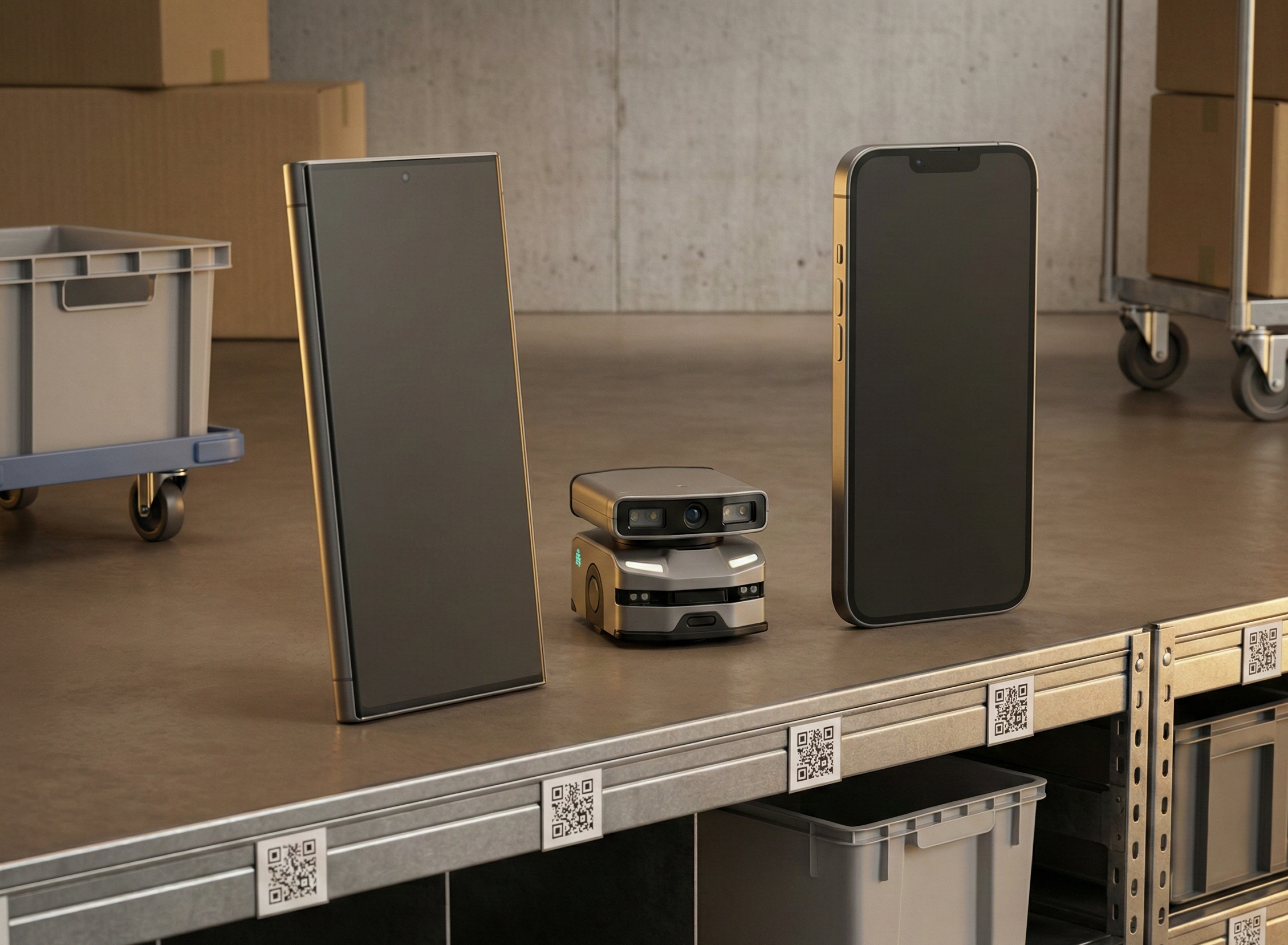
Problem
Enterprise demands for data capture technology are evolving rapidly. Simple barcode scanning alone can no longer address the increasingly complex challenges of supply chain transparency, real-time inventory tracking, and the transition to 2D barcodes.
Solution
In 2025, seven key trends — AI computer vision, contextual capture, hybrid device ecosystems, and more — are fundamentally transforming how physical data is captured in the field. Software-first approaches are replacing large hardware investments, enabling enterprise-grade performance from existing mobile devices.
Outcome
- Gartner predicts 70%+ enterprises will adopt smart data capture by 2027
- 45% of Fortune 500 companies have initiated SDC pilots (IDC 2025)
- AI computer vision delivers faster business value than GenAI
- GS1 Sunrise 2027 accelerating transition to 2D barcodes
- Software-first strategies dramatically reducing hardware costs
Why Smart Data Capture, Why Now
Smart Data Capture (SDC) is no longer a future technology — it's an enterprise imperative. Gartner predicts that by 2027, more than 70% of enterprises will adopt SDC, and according to a 2025 IDC report, 45% of Fortune 500 companies have already initiated SDC pilots.
The global Automatic Identification and Data Capture (AIDC) market was valued at $69.8 billion in 2024 and is projected to reach $136.9 billion by 2030, growing at a CAGR of 11.7%. This growth is driven by AI computer vision, increasingly powerful mobile devices, and flexible software-first deployment strategies.
In this article, we analyze the 7 key trends that are fundamentally reshaping how enterprises capture physical data in 2025.
Trend 1: AI Computer Vision Delivers Real Business Value
The AI delivering the most value in enterprise operations in 2025 isn't generative AI like ChatGPT — it's computer vision.
According to Gartner's 2024 AI Hype Cycle, computer vision has already reached the Plateau of Productivity, while GenAI still needs 2-5 years to get there. This means computer vision is already generating proven business outcomes.
Real-world applications:
- Shelf intelligence — AI automatically detects misplaced products, stockouts, and pricing errors on retail shelves
- Damaged barcode recognition — AI reconstructs and reads crumpled, torn, or partially obscured barcodes
- Fake ID detection — Real-time identification fraud detection with 99.9% accuracy
Zebra Technologies reported that deploying SDC at U.S. automotive plants in 2025 resulted in 30% faster quality inspections. Coca-Cola achieved a 25% reduction in paperwork time after SDC implementation.
Trend 2: The Rise of Contextual Data Capture
If traditional data capture was about "reading a single barcode," 2025's data capture is evolving into intelligent capture that understands the surrounding context.
What is contextual capture?
When multiple barcodes are visible in the camera view, AI analyzes the user's intent and environmental context to capture only the correct barcode. For example, even with dozens of products on a shelf, it recognizes only the barcode on the item the user is holding.
Real-world impact:
Smart Label Capture simultaneously captures barcodes and printed text like expiry dates and serial numbers in a single scan. One major U.S. retailer eliminated label scanning errors using this technology, saving $1.3 million annually.
Trend 3: GS1 Sunrise 2027 — The Great Barcode Transition
The 1D barcode (UPC/EAN) that has served retail for 50 years is being replaced by 2D barcodes (QR codes, DataMatrix). Under the GS1 Sunrise 2027 initiative, all POS systems must be able to read 2D barcodes by the end of 2027.
Why 2D barcodes?
- Data capacity: 1D barcodes store up to 30 digits; 2D barcodes store up to 7,000 characters
- Rich information: Expiry dates, batch numbers, country of origin, allergen data — all in a single code
- Consumer experience: Smartphone QR scans reveal nutritional info, sustainability certifications, and more
Currently, 48 countries (representing 88% of global GDP) are testing 2D barcode transitions. Starting in 2028, manufacturers may choose to print only 2D barcodes without the traditional 1D barcode.
What enterprises should prepare now:
- Verify POS scanner compatibility with 2D barcodes
- Confirm barcode software supports QR codes and DataMatrix
- Test reading small 2D barcodes on electronic shelf labels (ESL)
Trend 4: Data Capture as the Key to Supply Chain Transparency
Consumers increasingly want to know where products come from, whether they were ethically produced, and what ingredients they contain. Barcode scanning is becoming the critical link between physical products and digital information.
France's Yuka app exemplifies this trend. Consumers scan a product barcode to instantly see nutritional grades, additive risk levels, and healthier alternatives. With over 57 million users worldwide, the app has pushed manufacturers to reformulate recipes to improve their Yuka scores.
B2B applications:
- Cold chain logistics — Track temperature history of pharmaceuticals and food linked to barcode scans in real time
- Recall management — Precisely identify affected products by batch number, minimizing recall scope
- ESG reporting — Track carbon footprint from raw materials to finished products via barcode-based data
Trend 5: Software-First Strategy Over Hardware Investment
In times of economic uncertainty, enterprises prefer flexible software-based approaches over multi-million-dollar hardware replacements.
Cost comparison:
| Factor | Dedicated Scanner (PDA) | Software SDK + Smartphone |
|---|---|---|
| Device cost | $800-1,500 per unit | Use existing smartphones (no extra cost) |
| Training | Separate training required | Workers already familiar with the device |
| Scalability | Must purchase more devices | Just add licenses |
| Updates | Manual firmware updates | OTA automatic updates |
Semi-automation is also a key theme. Rather than full automation, enterprises are progressively integrating wearables, smart carts, and smart shelves into existing workflows — a strategy that achieves higher ROI through cost efficiency and flexibility.
Trend 6: Hybrid Device Ecosystems
Data capture in 2025 is no longer confined to a single device. Smartphones, fixed cameras, drones, wearables, and robots are connected as one ecosystem, each contributing their unique strengths.
Operational scenarios:
- Fixed cameras at warehouse entrances automatically scan pallet barcodes
- Smart glasses enable hands-free picking operations
- Drones perform automated inventory counting at elevated storage locations
- Smartphones in the hands of last-mile drivers capture proof of delivery
These systems are managed through a single software platform. Data from each device flows to a central system in real time, giving managers instant visibility into delays, bottlenecks, and operational status.
Trend 7: Automated Identity Verification Becomes Essential
With deepfake technology advancing and counterfeit IDs becoming more accessible, automated identity verification is rapidly becoming critical.
Manual visual checks are no longer sufficient. AI-powered ID verification systems can:
- Scan and verify over 2,500 ID types in under one second
- Process data on-device so personal information never leaves the phone
- Automatically detect tampering through hologram, microprint, and security feature analysis
Industries requiring identity verification — financial services, car rental, hospitality, age-restricted sales — are accelerating the shift from manual to automated checks. On-device processing is also preferred for compliance with privacy regulations like GDPR and CCPA.
What This Means for Your Business
These 7 trends have direct implications for enterprises across industries:
- Retail: Preparing POS systems for GS1 Sunrise 2027 is urgent. Smartphone-based Scan&Go and inventory solutions will accelerate.
- Logistics & warehousing: Hybrid device ecosystems can dramatically improve receiving, picking, and counting efficiency.
- Manufacturing: AI-powered scanning for quality inspection and MES integration reduces both manual entry errors and inspection time.
- Healthcare: AI scanning enhances both safety and efficiency in medication tracking, specimen management, and patient identification.
Data Connect, as an official SCANDIT partner, designs smart data capture solutions optimized for each industry and field environment. Contact us to discuss how these trends can accelerate your digital transformation strategy.