The Barcode You See Every Day Is Changing — 5 Reasons the World Moves to 2D
Executive Summary
The 1D barcode has been the standard we see every day for 50 years, but it can no longer carry the information, precision, and automation industry now demands. That is why every body that sets or regulates barcode standards — GS1, ISO, the US FDA, Korea's MFDS — is pushing or mandating the move to 2D. Five reasons sum it up.
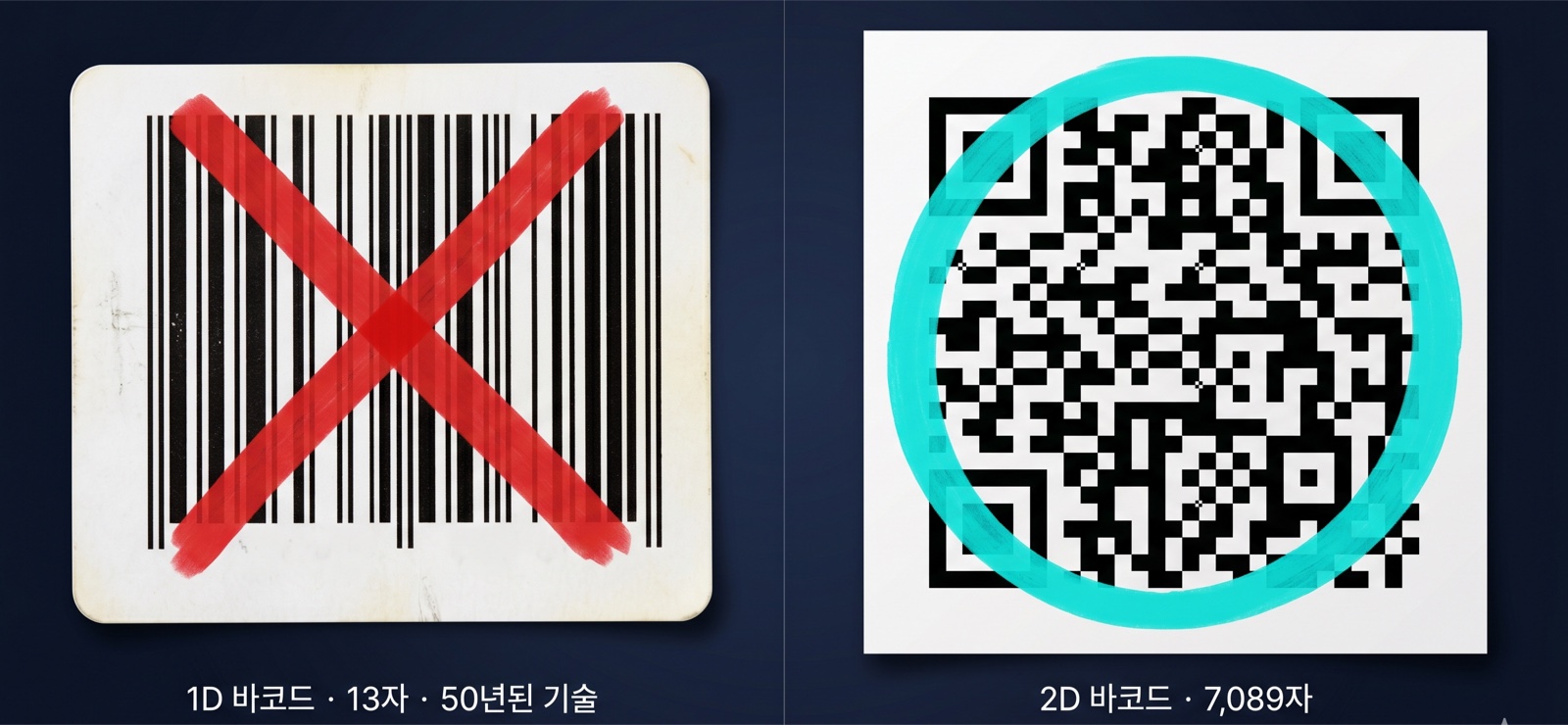
- Capacity: A supermarket barcode (EAN-13) holds 13 numeric characters. A 2D QR Code holds 7,089; a Data Matrix holds 3,116. That is roughly a 540× difference.
- Recovery: A 1D code fails when a single bar is damaged. 2D codes embed mathematical error correction — QR Code recovers from up to 30% damage and restores the original data.
- Harsh environments: 2D codes read through faded print, abraded labels, and cold-chain condensation. They can be marked directly on small parts, curved surfaces, and medical devices via direct part marking (DPM, Direct Part Marking).
- Ease of scanning: 1D codes require near-parallel alignment to the bars. 2D codes read from any of 360° of orientation, with higher decode accuracy and longer read distance — workers no longer waste time aligning angles or rescanning.
- Validated impact: Woolworths Australia, after adopting GS1 DataMatrix, cut food waste by up to 40% and raised productivity by 21% (GS1 official case study).
One more shift on top of these five — 2D barcodes are evolving from a back-of-house tool into a consumer-facing interface that people read straight from their phones. The question facing decision-makers is no longer whether to move to 2D. It is when, with what integration design, and along what cost curve.
The Structural Limits of 1D After 50 Years
The 1D barcode has been the de facto industrial standard since the 1970s. But the unit of data has shifted — from "what is this product" to "which batch of this product, made when, valid until when" — and 1D structures are no longer sufficient.
Capacity and single-purpose — identification only. EAN-13 holds 13 numeric digits (the last is a check digit). Code 128 (ISO/IEC 15417) has no formal length limit, but printed width grows linearly with character count, so practical limits sit near 30 alphanumeric or 60 numeric characters. The result: 1D tells you the GTIN, but batch, lot, expiry, and serial number live in a separate database lookup. Encoding all of those at once requires multiple separate barcodes on the same label. That translates into entire-lot recalls, no automated POS expiry blocking, no pharmaceutical serialization traceability, and limited cold-chain visibility — all direct operational costs.
Error and environment — one damaged bar is enough to fail. A 1D check digit can detect a corruption but cannot reconstruct it. One damaged bar, a glare reflection, or a creased label is enough to fail a decode. 1D scanners also require near-parallel alignment to the bars, making 1D effectively unusable on small parts, curved surfaces, or medical-device direct marking.
Three Operational Shifts 2D Brings
2D barcodes — Data Matrix and QR Code — encode information across both horizontal and vertical axes. The change is not just larger capacity. It is a shift across three operating axes at once.
1. Ease of scanning — any direction, longer distance, higher accuracy
A 1D scanner requires near-parallel alignment to the bars. A 2D code carries a built-in finder pattern and decodes from any orientation. Whether a box rotates on a conveyor, a robot vision system views from an unusual angle, or a worker holds a smartphone at a tilt, the result is the same decode.
That freedom is not just convenience. Decode accuracy improves, and the same camera can read from a longer distance. Conveyor throughput rises and robot pick-and-place cycle time shortens. As standard cameras become viable capture devices, smartphones become the primary data-capture tool, even without dedicated 1D laser scanners.
2. Data recovery — mathematical error correction
The most fundamental advantage of 2D is that Reed-Solomon error correction is built into the standard itself. QR Code (ISO/IEC 18004) defines four ECC levels — L, M, Q, H — recovering approximately 7%, 15%, 25%, and up to 30% of damage to the original data. Data Matrix (ISO/IEC 16022 ECC 200) uses the same mechanism.
This raises decode rates in every environment where labels are handled roughly. Cold-chain condensation, abrasion in warehouses, chemical exposure, outdoor weathering — situations where a 1D code would have failed, a 2D code actively reconstructs the missing data. This is the most direct mechanism by which 2D reduces unplanned line stoppages on automated lines.
3. Robustness in harsh recognition environments
Data Matrix carries harsh-environment robustness in its standard. It is readable at roughly 20% contrast, so faded print or uneven surfaces still decode. It fits about 50 characters in a 2–3 mm square, making it the de facto standard for marking medical devices and small electronic components. Aerospace, defense, and automotive industries laser-etch Data Matrix directly onto parts using DPM (Direct Part Marking), with quality requirements defined by ISO/IEC 29158 and AS9132. And the GS1 Application Identifier system encodes GTIN (01), batch (10), expiry (17), and serial (21) in a single code using standardized field syntax.
1D vs 2D — Operational Comparison
| Aspect | 1D Barcode | 2D Barcode |
|---|---|---|
| Max numeric capacity | 13 (EAN-13) to ~60 (Code 128) | 3,116 (Data Matrix) / 7,089 (QR Code) |
| Data types stored | Identifier (GTIN) only | Identifier + batch + expiry + serial + URL + binary |
| Error recovery | Check digit only (detect, no recovery) | Mathematical recovery (partial damage recoverable) |
| Scan direction | Near-parallel to bars | Any direction, 360° |
| Print area for same data | Grows with digit count | Data Matrix: 50 chars in a 2–3 mm square |
| Low-contrast tolerance | Requires high contrast | Data Matrix: ~20% contrast sufficient |
| Direct part marking (DPM) | Effectively unfit | Data Matrix is the standard |
| Recall precision | Product line (full pull) | Batch / lot / serial (surgical pull) |
| Scanner hardware | Laser scanners | Camera-based capture (smartphones) viable |
The Direction of the Standards — Global Momentum
GS1's Sunrise 2027 initiative aims to make every retail POS system 1D-and-2D capable by the end of 2027. Pilots run in 48 countries, covering 88% of global GDP. Walmart, Tesco, and Carrefour are among the major retailers driving this forward. GS1 Korea (Korea Chamber of Commerce, Distribution Industry Promotion Division) supports the same shift via its "Global 2D Barcode Transition Plan."
Healthcare is moving faster. The US FDA's Unique Device Identification (UDI) rule mandates machine-readable identifiers on medical device labels, and in practice GS1 DataMatrix has become the standard. For food, FDA FSMA Rule 204 requires traceability data within 24 hours — effectively impossible with 1D alone. In Korea, serial number marking on prescription pharmaceuticals has been mandatory since January 1, 2015, and Korean medicine packaging already carries GS1-128 or GS1 DataMatrix.
In manufacturing, the automotive industry uses Data Matrix DPM extensively for parts traceability and recall precision; aerospace and defense rely on ISO/IEC 29158 and AS9132 for DPM quality; semiconductor manufacturing has standardized on Data Matrix for wafer-level identification in clean rooms.
2D in the Consumer's Hand — A New Interface
Everything above is about what happens inside the supply chain. But 2D is taking one more step beyond that. It is becoming a consumer-facing interface that people read straight from their own phones, retrieving information the manufacturer itself has registered.
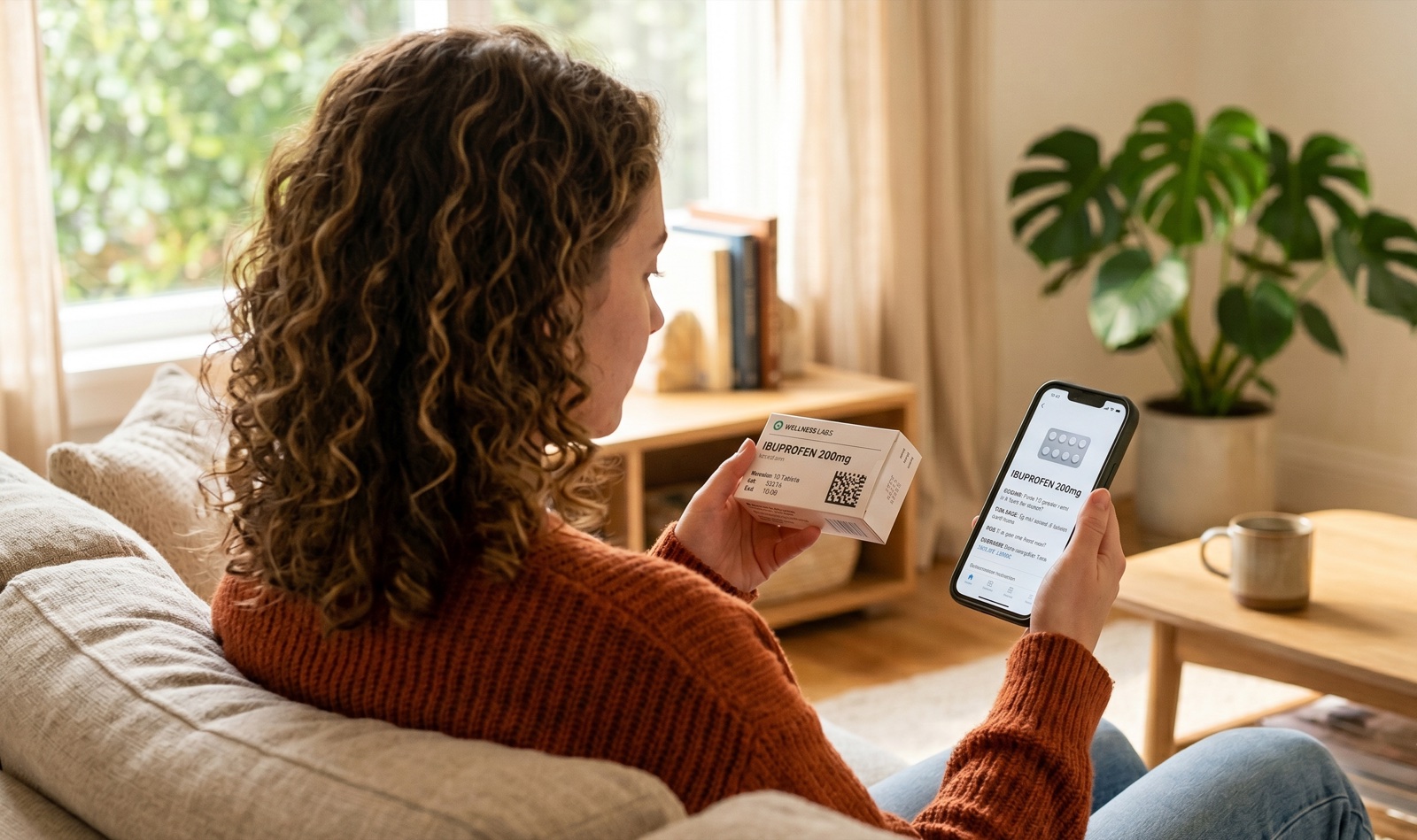
The clearest signal arrived in November 2025: GS1 and Google announced a collaboration in which Google Lens natively recognizes the roughly 16 billion GS1 DataMatrix codes already printed on pharmaceutical packaging, opening directly to the manufacturer-registered medicine information page — no app required. A patient who lost the paper leaflet, bought the medicine abroad, or kept it in a cabinet for years can pull up the information from a smartphone in seconds.
There is no reason the same mechanism stops at pharmaceuticals. Food, cosmetics, apparel, electronics — every industry that uses GS1 barcodes is a candidate. Pointing a phone at a supermarket shelf could surface origin, nutrition, allergens, authenticity, and reviews instantly. A barcode that was once strictly B2B infrastructure is being promoted into a B2C interface.
AI search rides on the same rail. When ChatGPT, Claude, or Gemini answers a product question, a manufacturer-registered canonical URL serves as a trustworthy citation source. A single 2D barcode on the label now reaches the patient's phone, the supermarket shopper's camera, and AI search citations simultaneously.
For brands, the questions this raises are concrete: register a canonical URL on the label or not, expose what information to which audience, and how to be recognized by AI search. These touch the next five years of marketing, branding, and customer-experience strategy directly.
Deeper analysis: Patients Are Now Reading Their Own Medicine Barcodes With a Phone — GS1×Google Digital Link
Validated Impact — Woolworths Australia
Woolworths is Australia's largest retailer, with over 1,000 stores and roughly 20 million customers per week. In August 2019, in partnership with GS1 Australia, the company introduced GS1 DataMatrix on fresh meat and poultry — the first such deployment in Australia. By early 2022, 50% of the meat category across more than 1,000 stores carried 2D codes. The encoded data: GTIN, batch/lot, use-by date, supplier, weight, and price. The results published by GS1:
| Metric | Outcome |
|---|---|
| Food waste reduction | Up to 40% reduction |
| Productivity gain | Up to 21% from automated expiry management |
| Recall precision | Batch-level identification → avoids unnecessary disposal of unaffected stock |
| POS expiry blocking | Expired items automatically blocked at the register |
| Automatic markdown | Near-expiry items priced automatically, removing manual relabeling |
The key insight: the impact comes from integrating data that 1D could not carry (batch, expiry, serial) into a single 2D code and connecting it to POS and inventory systems. The result is produced by the data-and-systems integration that 2D enables, not the 2D code in isolation.
Five Things Decision-Makers Should Audit Now
- Scanner hardware — legacy 1D laser scanners cannot read 2D. Software scanners such as SCANDIT, running on smartphones, flatten the hardware investment curve.
- Print quality — 2D requires module-level precision. Once damage accumulates beyond ECC headroom, even the recovery mechanism cannot keep up. Print-inspection automation needs to follow.
- System data model — ERP, WMS, and POS must be able to consume batch, expiry, and serial fields. If downstream systems cannot use the data, only the label changes and operational impact does not appear.
- GS1 standards literacy — custom encodings break global interoperability. Use standard AIs: (01) GTIN, (10) batch, (17) expiry, (21) serial.
- Dual-mode transition design — 1D and 2D will coexist for a period. Supply chains and stores must be able to read both, and the bridge period needs to be designed explicitly.
Conclusion
For 50 years, 1D barcodes carried global industry. As the unit of data has shifted from identification to traceability, automation, and the consumer-facing interface, 1D is hitting structural limits. GS1, ISO, the FDA, and Korea's MFDS all point the same way; Woolworths validated the operational impact (40% food waste reduction, 21% productivity gain); and the GS1×Google collaboration extends the same barcode into the consumer's hand.
The decision is no longer whether to move to 2D. It is timing, integration design, and cost curve. The standards have already turned, and the early movers climb the data, systems, and interface learning curve first.
References
- GS1, "Industry Endorsement Statement: QR Codes with GS1 standards" — Sunrise 2027
- GS1, "Woolworths Australia seeing multiple benefits from 2D barcodes" — Official case study
- GS1 Korea (Korea Chamber of Commerce, Distribution Industry Promotion Division), "Global 2D Barcode Transition Plan"
Data Connect is the official SCANDIT partner in Korea, covering enterprise data capture industry trends and standards.