

When You Can't Attach a Label, You Engrave the Barcode — A Guide to DPM (Direct Part Marking)
Key Takeaways
Traceability on the factory floor usually starts with a label. But some things can't carry one: engine parts that endure high heat, PCBs washed in solvents, surgical instruments sterilized hundreds of times. For these parts, the barcode is marked straight onto the surface — this is DPM, Direct Part Marking.
- How it's applied: laser etching, dot peening (pneumatic pin impact), scribing, thermal transfer. The code lives as long as the part does.
- The code is almost always Data Matrix: it fits in a few millimeters per side, and Reed-Solomon error correction under ECC 200 (ISO/IEC 16022) keeps it readable with up to 30% of the code area damaged.
- The hard part is reading it: no ink contrast, metal glare, curved-surface distortion, modules scattered into dots — every assumption a conventional barcode reader makes is broken.
- The fix is software: the SCANDIT SDK turns an ordinary smartphone camera into a DPM reader by enabling Direct Part Marking mode and Color Inversion in the Data Matrix settings.
Where Labels Can't Go, Codes Are Engraved
A barcode label is paper or film. It melts under heat, swells in oil, wears off with friction, and detaches in washing and sterilization cycles. For the following parts, a label was never an option.
- Automotive and aerospace parts — engine blocks and turbine blades exposed to heat, pressure, and vibration. Part-level identification is mandatory for recalls and maintenance history.
- Electronics — PCBs and chip-scale components. There's no surface area for a label, and the part must survive reflow soldering temperatures.
- Medical devices — reusable surgical instruments go through hundreds of cleaning and sterilization cycles. The US FDA's UDI rule requires direct marking on the device itself.
- Defense — the US Department of Defense uses Data Matrix marking as the standard for Item Unique Identification (IUID).
So the code goes onto the surface itself: burned in by laser (laser etching), hammered in dot by dot with a pneumatic pin (dot peening), or scratched in with a stylus (scribing). Once marked, the code accompanies the part through its entire life cycle — manufacturing, assembly, maintenance, retirement. The part carries its own résumé.
The code engraved is almost always Data Matrix, for two reasons.
- It's small — the smallest symbols go down to roughly 1–3 mm² while a square symbol can hold up to 3,116 numeric characters.
- It's tough — Reed-Solomon error correction built into the ECC 200 standard (ISO/IEC 16022) recovers the original data with up to 30% of the code area damaged.
Exactly the right properties for an environment where wear and corrosion are the default.
Why Ordinary Scanners Fail
Barcode reading technology evolved for decades on one assumption: dark ink, light background, flat label. DPM breaks all of it.
There is no ink contrast. Printed barcodes get their contrast from ink. Engraved codes have none — only the faint shading that surface micro-relief produces under light. To a standard decoder, the contrast is too weak to even register that a code exists.
Metal reflects. A machined metal surface behaves like a mirror. Depending on the lighting angle, parts of the code wash out in specular glare, and the same part reads or fails depending on how you hold it. This is why dedicated DPM scanners ship with special optics like dome illumination.
Surfaces aren't flat. A code marked on a cylindrical shaft or curved housing reaches the camera distorted — fatal for Data Matrix, which depends on precisely locating grid modules.
Dots replace modules. A dot-peened code is a set of separated dots, not connected square modules. Algorithms that look for module boundaries can't reconstruct the grid from a dot pattern.
The colors are inverted. Codes marked bright on dark metal have contrast opposite to a printed barcode (inverse codes). To a reader that can't handle color inversion, the code is invisible.
These conditions kept DPM reading in the realm of dedicated hardware for years — fixed-mount and handheld DPM scanners with special illumination and decoders, installed line by line.
Reading DPM with a Smartphone Camera
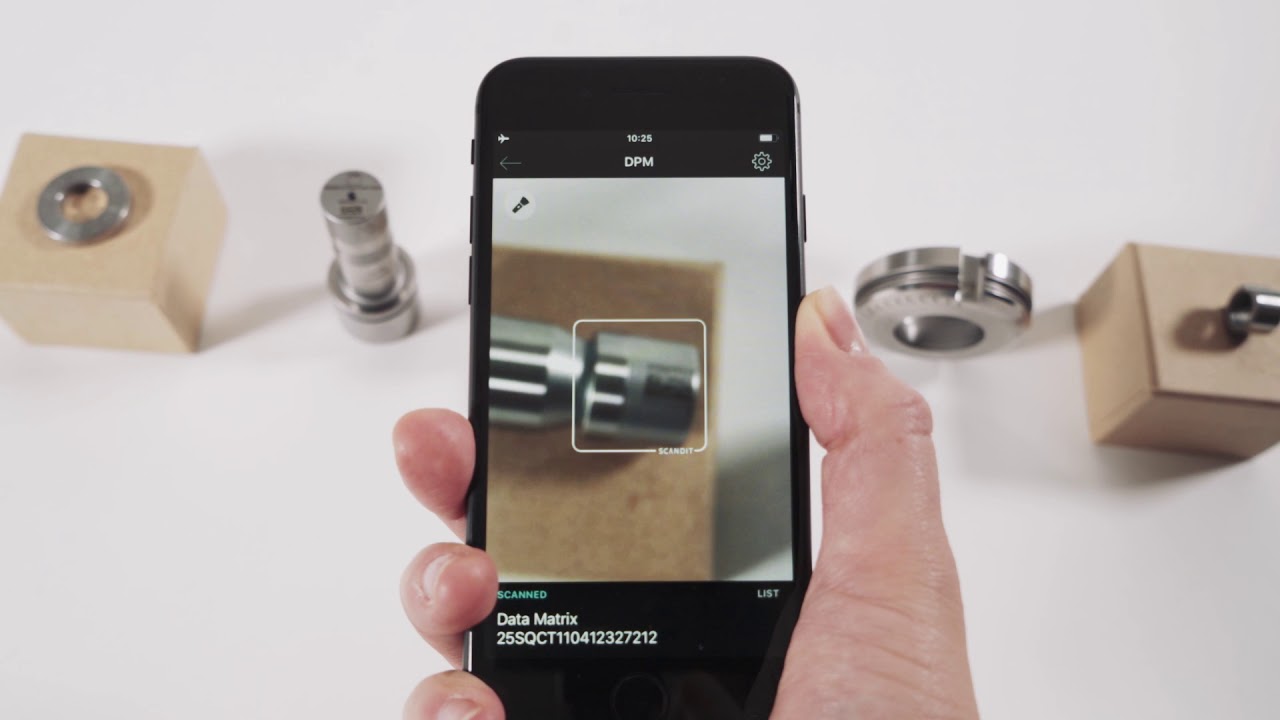
SCANDIT's approach solves this in software rather than hardware. Below is the official SCANDIT demo — an ordinary smartphone reading tiny engraved Data Matrix codes on metal parts.
The configuration is simple. In the SDK's Data Matrix symbology settings, enable two things:
- Direct Part Marking mode (the
direct_part_markingextension) — activates recognition of codes engraved or etched into metal, handling dot-peen patterns and low-contrast engravings. - Color Inversion — enables reading of inverse Data Matrix codes marked brighter than their background.
On top of that, the software corrects perspective and non-linear distortion and handles degraded conditions — low light, long distances, awkward angles, partial occlusion. The camera plus algorithms take over the role of special optics.
Operationally, the difference is a cost-structure difference. Instead of placing dedicated DPM scanners on every line and with every worker, the smartphones, tablets, and rugged devices you already own become DPM readers. Receiving inspection, assembly lines, maintenance depots, field repair — recognition capability follows wherever engraved parts are handled, with no extra hardware.
A Domain Defined by Standards
DPM is not a niche technique; it's a standardized industrial requirement.
| Industry | Standard / Regulation | Scope |
|---|---|---|
| Aerospace | AS9132 | Data Matrix marking quality criteria for aerospace parts |
| Automotive / general manufacturing | ISO/IEC 29158 | DPM code quality assessment guideline |
| Electronics | EIA CEA-706 | Data Matrix marking standard for small components |
| Defense | US DoD IUID | Item Unique Identification — requires Data Matrix marking |
| Medical devices | US FDA UDI | Direct marking required on reusable, re-sterilized devices; GS1 DataMatrix in practice |
In industries where part-level traceability is a regulatory requirement, "marked but unreadable on the floor" is a compliance risk. Invest in marking equipment without solving the reading step, and the traceability data simply never accumulates.
Closing
DPM is the standard way to keep parts traceable where labels can't survive, and the code is almost always Data Matrix. The hard part was never the marking — it was the reading: inkless contrast, metal glare, curved surfaces, dot patterns, inverted colors. The territory once owned by dedicated scanner hardware is now handled by software-based scanning on an ordinary smartphone camera. If your operation handles engraved parts, the reading step can be reframed from a hardware purchase into a software setting.
For the full picture from receiving inspection to process tracking on the factory floor, see our manufacturing solutions page.
References
- Scandit, "Data Matrix Barcode" — official symbology page
- Scandit Support, "How to Improve Barcode Detection for Direct Part Marking (DPM) DataMatrix codes"
- Scandit official demo, "Scan Tiny DataMatrix Codes Used In Direct Part Marking (DPM)"
Data Connect, SCANDIT's official partner in Korea, covers industry trends and technology in enterprise data capture.
FAQ
Related Posts
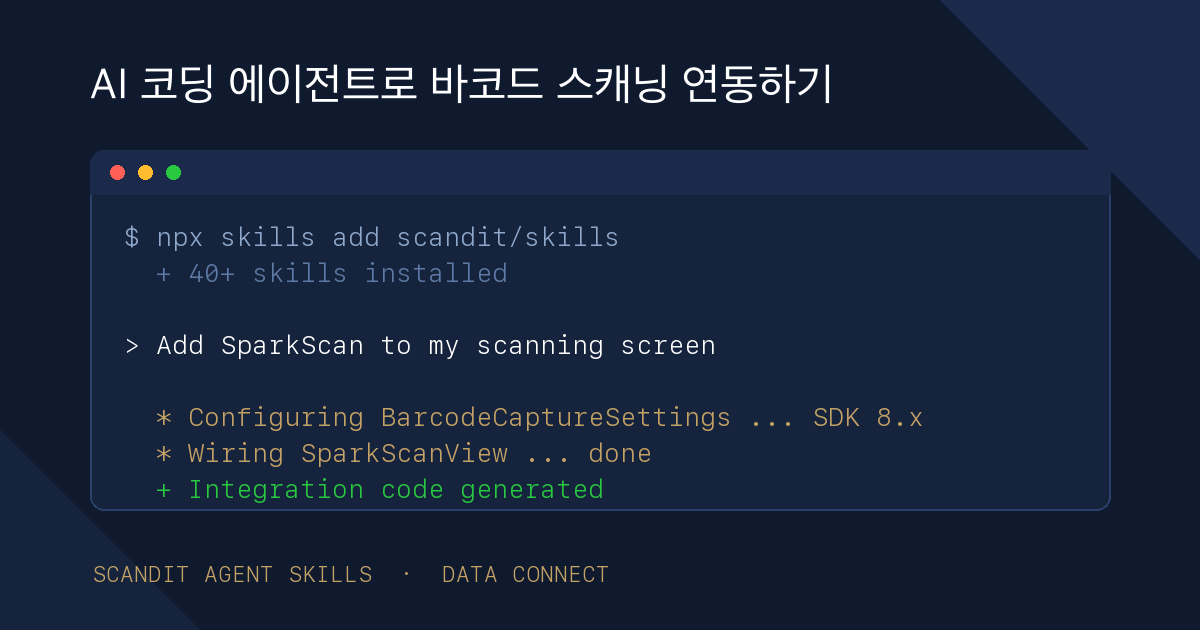
Integrating Barcode Scanning with AI Coding Agents — Scandit Agent Skills
Scandit has released official Agent Skills that teach AI coding agents — Claude Code, Codex, Cursor and more — how to integrate the Scandit SDK correctly. One install command, and your agent writes integration code against the latest SDK version. Here is what changes, and how teams in Korea can put it to work.
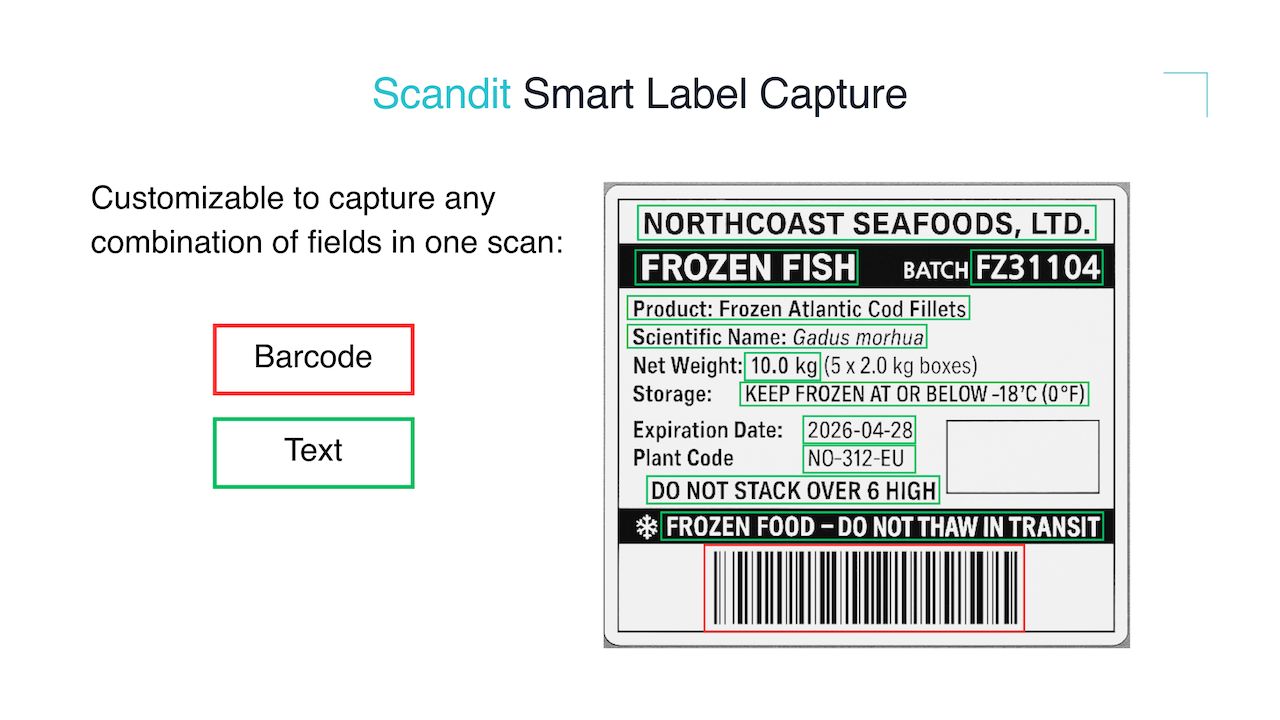
Beyond Barcodes: The Rise of Smart Label Capture
Expiry dates, prices, VINs — automatically capturing all information on a label with a single scan.

The Evolution of AI-Powered Scanning: How SDK 8.0 Is Changing the Field
Next-generation AI scanning technology that understands intent and adapts to context is transforming frontline operations.