

Luxury DPP Compliance: the Big Problem of Tiny Engraved Codes
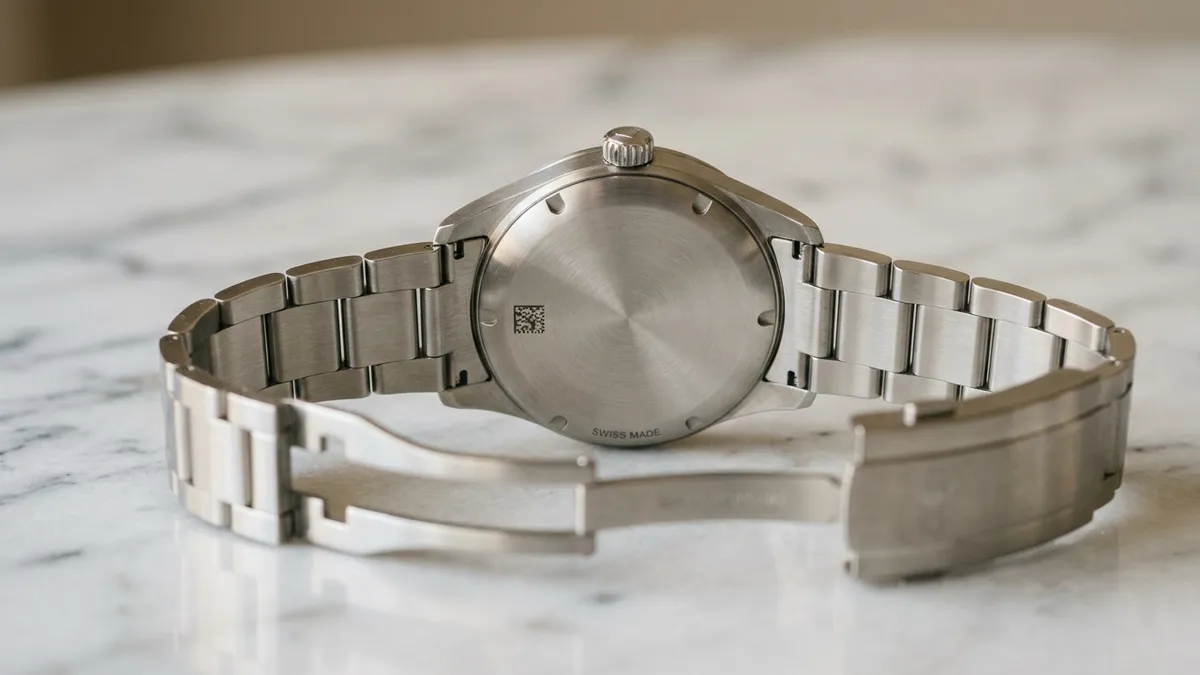
Problem
The EU DPP regulation requires a machine-readable identifier permanently attached to the product itself. For watches and jewelry that cannot carry a label, a 2-3mm Data Matrix code laser-engraved into the metal is effectively the only option — and its low contrast, inverted patterns, curved surfaces, and tiny modules make it nearly unreadable for standard barcode scanners.
Solution
Scandit's AI scanning engine supports DPM (Direct Part Marking) codes, reading engraved metal codes without specialist hardware. Color-inverted decoding, distortion correction, and a GS1 parser come built in, integrated via SDK into the smartphone apps store associates and consumers already use.
Outcome
- First-try scans across the full lifecycle: receiving, point of sale, repairs, resale, returns
- No dedicated scanner hardware — integrates into existing mobile apps
- Authentication coverage for the €48 billion secondhand luxury market
- A defense against returns fraud (9% of all returns; decoy returns up 64%)
The Digital Product Passport (DPP) is no longer a future problem for the luxury industry. The EU's DPP central registry went live in July 2026, and luxury textiles and apparel brands are expected to comply from mid-2028. Here is Scandit's read on where luxury retail stands — and the scanning challenge hiding inside the regulation.
What DPP Requires: On the Product, Permanently
A DPP is a structured digital record of an item's origin, composition, manufacturing, and lifecycle. It travels with the product from factory to checkout, from resale to recycling.
The critical requirement is where the carrier lives: not the box, not the certificate, not the packaging — the product itself. It must survive washing, wear, and years of handling while remaining readable by a mobile device at any point in the chain.
Soft goods can carry a label sewn into a lining. The hard cases are watches, rings, bracelets, and sunglasses — items with no room for a label at all. There, the identifier must be engraved directly into the material, and the leading candidate is a laser-engraved Data Matrix code.
Watches and jewelry are not yet mandated, but voluntary adoption is rising as brands get ahead of counterfeiting, transparency demands, and visible compliance deadlines. Nobody wants a visible code on a five-figure watch, so the engraving is typically 2-3mm wide and hidden from view.
Why a 2mm Engraved Code Is So Hard to Scan
The same properties that make engraved codes permanent and tamper-proof also make them exceptionally difficult to read.
- Low contrast — A printed label offers clean contrast; engraving relies on texture, shadow, and reflectivity that most scanners cannot detect.
- Finder pattern loss — 2D codes depend on finder patterns (the three corner squares of a QR code, the solid L of a Data Matrix) to locate and orient the symbol. If reflections or wear obscure them, decoding never starts.
- Curved surfaces — A 2D code must be captured as a complete grid. On a ring or bracelet, the code warps across multiple planes.
- No error-correction margin — Data Matrix uses Reed-Solomon error correction, tolerating up to 30% damage. But tiny codes are often encoded at lower correction levels with fewer modules (10x10 instead of 16x16), leaving almost no margin in practice.
These codes fall into the DPM (Direct Part Marking) category, where traditional scanning hardware falls short. We covered the manufacturing side of this challenge in our DPM Data Matrix scanning guide.
The Moments Where a Failed Scan Hurts
Why does one tiny code matter so much? Walk the lifecycle.
- Inventory receiving — Every item entering the store is logged against its DPP record to confirm authenticity and batch. A failure here corrupts stock accuracy from the start.
- Ownership transfer at the point of sale — A client advisor standing with a customer who just decided to spend thousands should not be wrestling with a scanner. Protecting that emotional peak is the luxury experience.
- Consumer apps — Customers scan at home for care instructions, provenance, and documentation, with no associate present to smooth over a failure.
- Repairs and resale — The secondhand luxury market reached an estimated €48 billion in 2024, with watches and jewelry accounting for 80-85% of sales. A failed scan at a repair desk or authorized reseller leaves an item's history in limbo.
- Returns authentication — A 2025 NRF report found 9% of all returns were fraudulent, with decoy returns (counterfeits in genuine boxes) up 64%. A reliable scan at the returns desk directly protects the P&L.
The Fix: DPM Scanning Without Specialist Hardware
Scandit's AI scanning engine is built to handle DPM codes, including laser engravings on metal. For luxury retail, the key capabilities are:
- Accelerated localization and decoding of square and rectangular symbols with perspective and non-linear distortion
- A color inversion setting that lifts recognition rates on low-contrast engravings
- Instant GS1 recognition with a parser API that turns encoded data into usable structure — which also connects to the GS1 Digital Link transition
- SDK integration into the smartphone apps associates and shoppers already use — no dedicated scanners
A luxury house doesn't cut corners on materials, construction, or finish. The technology reading its products shouldn't either. Scanning a code that fits on a ring, on the first try — on day one or in year twenty at a resale shop — is its own kind of craftsmanship.
As SCANDIT's official partner in Korea, Data Connect supports DPM scanning proofs of concept and evaluation licenses. If you want to test recognition rates on your own engraved samples, contact our technical team.
FAQ
Related Posts
Meet Scandit at RetailTech JAPAN 2026 — March 3–6, Tokyo Big Sight
Scandit is exhibiting at RetailTech JAPAN 2026, March 3–6 at Tokyo Big Sight. Visit Booth RT6222 to see the world's leading software-based barcode scanning technology in action.

Four Pillars of Retail Computer Vision: Beyond Barcode Scanning
Barcode capture, OCR, shelf detection, and ID verification form a complete vision stack that gives retailers true operational visibility.
NRF 2026 Recap: Four Priorities That Defined the Conversation
Shelf accuracy, food waste, fulfillment scaling, and frontline empowerment emerged as the four themes every retailer was talking about.